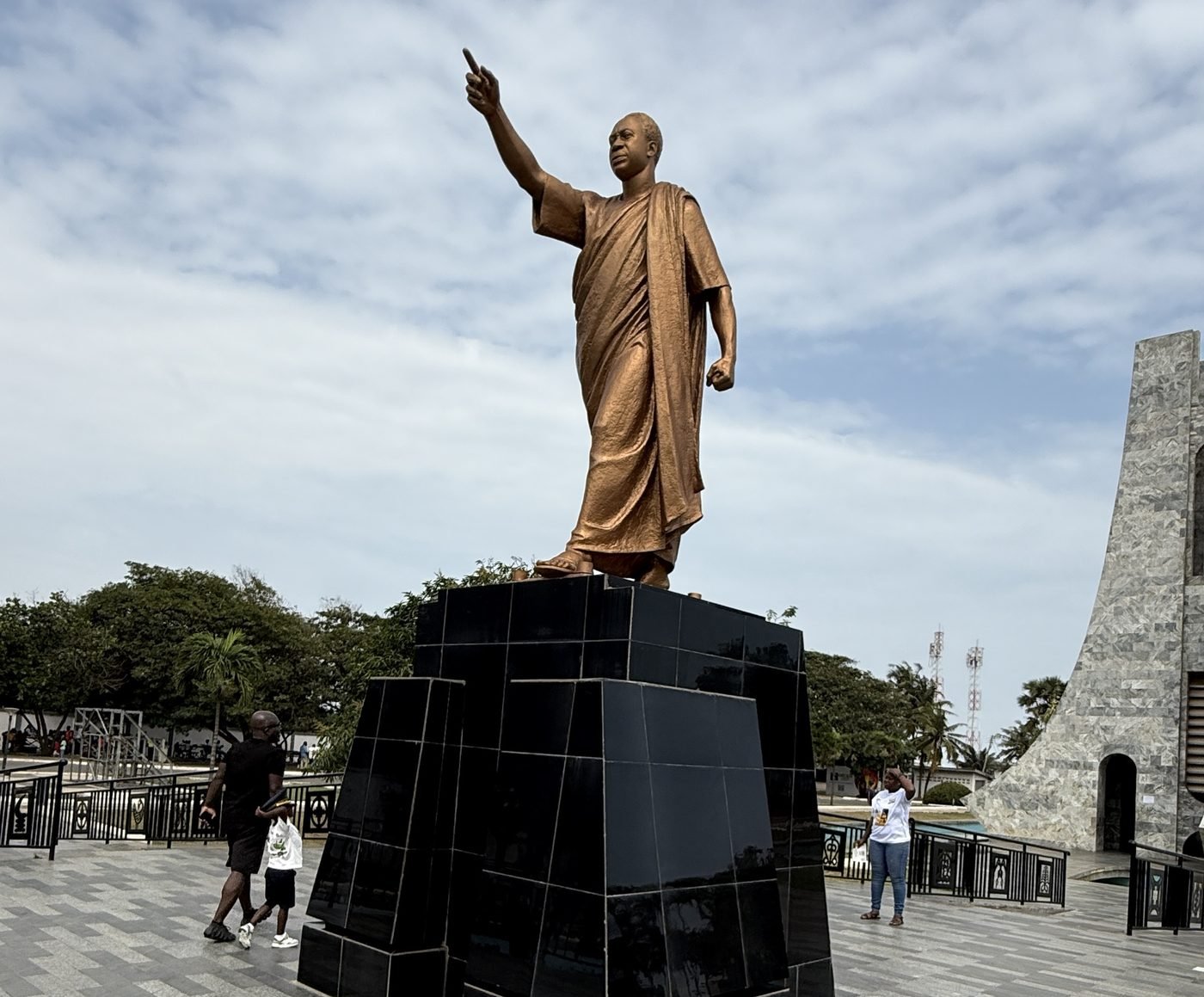
Perhaps observers of Ghanaian politics have been too polite about the condition of Nkrumahism.
Traditional Nkrumahists like to warn that their tradition risks becoming politically irrelevant. The warning is late. By the most basic electoral measure, irrelevance has already arrived.
The task before those who still believe the tradition holds something of value for Ghana, and it does, is therefore not preservation.
It is rescue, reconstruction and renewal.
A Three-Decade Collapse
Consider the trajectory.
When Ghana returned to constitutional rule in 1992, the Nkrumahist tradition was already fractured. Three Nkrumahist presidential candidates contested separately, and a much-discussed alliance among them never materialized. Hilla Limann's PNC took 6.7% of the presidential vote, Kwabena Darko's NIP 2.8% and Emmanuel Erskine's PHP 1.7%. Together they attracted more than 11% of the vote, roughly one Ghanaian voter in nine.
Then the slide.
By 1996, the PNC presidential vote had fallen to 3.0%. In 2000 it was roughly 2.9%, while the reconstituted CPP received 1.8%. By 2008, the CPP stood at about 1.3% and the PNC at 0.9%. By 2016, the CPP and PNC were each around a quarter of one percent, while Paa Kwesi Nduom's PPP, another party associated with the broader tradition, managed about 1%.
The parliamentary story is hardly more comforting. A University of Ghana thesis on Nkrumahist fragmentation records the CPP moving from one seat in 2000 to three in 2004, one in 2008 and none in 2012 or 2016. The PNC went from three seats in 2000 and four in 2004 to two in 2008, one in 2012 and none in 2016.
That is not an electoral bad patch.
It is a three-decade collapse.
And then came 2024.
In the Electoral Commission's updated results, the CPP's Nana Akosua Frimpomaa received 23,991 votes, approximately 0.20% of valid votes. The GCPP's Daniel Augustus Lartey Jnr. received another 17,299, approximately 0.15%. Nana Kwame Bediako, Cheddar, running as an independent at the head of his New Force movement, received 88,944 votes, or 0.76%.
Combined, the CPP and GCPP gathered 41,290 votes, about 0.35% of the 11.68 million valid votes counted.
Cheddar alone received more than twice that number.
In 1992, one voter in nine chose an Nkrumahist. In 2024, it was roughly one in 280.
The comparison is not perfectly like-for-like. Parties merged, split, disappeared and reconstituted themselves over those three decades, and the boundaries of the Nkrumahist electoral family shifted with them. But whichever reasonable definition one adopts, the direction of travel is impossible to miss.
An Inheritance Without the Family Name
Nor does it tell us that Ghanaian voters have rejected Nkrumah's ideas.
The history of the Fourth Republic suggests something more uncomfortable.
In 1992, a fourth Nkrumahist formation, the National Convention Party, chose not to field a presidential candidate at all. It joined Jerry Rawlings's NDC in the Progressive Alliance, and its leader, Kow Nkensen Arkaah, became the first Vice-President of the Fourth Republic. The alliance did not hold. In January 1996 the NCP broke with the NDC and merged into a reborn CPP, and by that year's election Arkaah was running as John Kufuor's running mate in the NPP-led Great Alliance. Nduom, a leading CPP figure, would later serve in three ministerial posts in Kufuor's government, Economic Planning, Energy and Public Sector Reform, without ever joining the NPP.
The pattern is hard to miss. Nkrumahist talent, votes and ideas did not vanish. They leaked into both of the parties that now dominate Ghanaian politics. The same University of Ghana research found that the major parties' exploitation of Nkrumahist factional warfare helped keep the tradition from recovering.
The NDC should not be described simply as an Nkrumahist offshoot. Its lineage runs through Rawlings, the PNDC and the revolutionary politics of the 1980s, and it built its dominance on eleven years of incumbency and the machinery of the state, not merely on ideological hospitality. But political scientists writing for Oxford University Press describe it as a conglomeration of both of Ghana's older traditions, and it came to occupy territory familiar to the Nkrumahist left: developmental government, social justice, Pan-Africanism, state responsibility for economic transformation.
It did so without requiring anyone to submit for certification as a doctrinaire Nkrumahist.
The explicitly Nkrumahist parties, meanwhile, kept fighting over lineage, leadership and custody of the tradition.
That does not prove the purity test drove voters away. Political realignment is more complicated than that. But it raises a question the tradition can no longer avoid: what if guarding the doctrine did not preserve Nkrumahism, but isolated the organizations claiming exclusive ownership of it?
The Fourth Republic has produced a political inheritance without the family name.
And ownership of Nkrumah's name is not the same thing as ownership of Nkrumah's inheritance.
So the question traditional Nkrumahists should be asking is not:
Why don't Ghanaians appreciate Nkrumah enough?
It should be:
What have Nkrumahists done with Nkrumah's political inheritance that, more than three decades into the Fourth Republic, this is where they find themselves?
That question requires introspection.
The Commemorative Reflex
Because there is something peculiar about a political tradition built around one of the most ambitious nation-builders in African history becoming associated with commemorating what its founder built rather than demonstrating what his political descendants can build themselves.
The pattern is familiar.
Memorial lectures.
Anniversary celebrations.
Monuments unveiled.
Speeches quoted.
Debates over who is and is not sufficiently Nkrumahist.
Arguments over ideological purity.
And then another election arrives.
The voters barely notice.
The week just past illustrates the pattern with unusual clarity. To mark Nkrumah's 117th birthday, the "Long Live Nkrumah's Freedom Arch" was commissioned at Axim Junction. In Ellembelle, the Lands and Natural Resources Minister unveiled the Osagyefo Roundabout, complete with a statue, at Sanzule. At the University of Cape Coast, Kwesi Pratt Jnr. delivered the 15th Kwame Nkrumah Memorial Lectures and received an honorary Doctor of Letters for his contributions to journalism, democracy and Pan-Africanism.
There is nothing wrong with any of this. Nations should preserve history. Universities should examine important political traditions. Ghana should honor people who have contributed substantially to its intellectual and civic life.
And to be fair, the speakers themselves saw the problem. Pratt argued that Nkrumah's legacy should be understood as an unfinished political project rather than a collection of commemorative symbols. The minister who unveiled the statue said the annual celebration should go beyond ceremony.
Everyone agrees.
That is precisely the difficulty.
The call to go beyond ceremony has itself become part of the ceremony. It is delivered from the podium, applauded, and everyone goes home.
Notice, too, who else was at the podium. The National Chairman of the NDC used the Sanzule unveiling to declare that attempts to erase Nkrumah from Ghana's memory had failed.
He is right. Nkrumah's memory is not disappearing. It is everywhere, on statues, roundabouts and university lecterns, invoked freely by parties that have never called themselves Nkrumahist.
Both of that week's new monuments were built by NDC members of parliament. The party that owes much to the Nkrumahist tradition, and never claimed its name, is now its most visible custodian.
The NDC now does more to honor Nkrumah than the Nkrumahists do.
Neither is doing much to advance what he built.
Which produces the deepest irony of all.
Nkrumah is considerably more politically successful than the Nkrumahists.
Traditions Die When They Fail to Reproduce
Preservation cannot substitute for political reproduction.
A monument can preserve Nkrumah's memory. It cannot produce the next generation of Nkrumahists.
A memorial lecture can examine Nkrumah's ideas. It cannot by itself transform those ideas into a political movement capable of attracting millions of contemporary Ghanaians.
And this is where traditional Nkrumahism must confront its most uncomfortable question: demography.
Walk into many Nkrumahist commemorations and ask: Where are the 20-year-olds? Where are the 25-year-olds? Where are the young engineers, entrepreneurs, programmers, creators, farmers, scientists and organizers who will carry this philosophy into 2050?
No published reporting I have found offers a reliable age profile of those who attend these events. The movement should commission that study rather than argue from impression, in either direction.
But if it cannot demonstrate substantial youth participation, that should be treated as an organizational emergency.
Because political traditions do not die when their founders die.
They die when they fail to reproduce themselves.
And ideological rigidity accelerates that process.
Too much energy goes into determining who qualifies as a "true Nkrumahist": whether someone holds the correct interpretation of Pan-Africanism, socialism, imperialism, capitalism, African unity, or some argument inherited from the ideological battles of the twentieth century.
This is not only an outsider's impression. The University of Ghana thesis identifies ideological rifts, leadership crises, weak party structures and excessive glorification of the founder among the self-induced causes of Nkrumahist fragmentation.
The result is a strange political paradox:
An increasingly exclusive definition of Nkrumahism, governing an increasingly small community of Nkrumahists.
The doctrine becomes purer.
The electorate becomes smaller.
Eventually you can have ideological perfection and electoral extinction at precisely the same time.
That would be an extraordinary fate for a movement whose founder was an organizer, a coalition-builder and a relentless seeker of state power.
What Have Today's Nkrumahists Built?
Nkrumah did not spend his political career organizing annual lectures about Nkrumahism.
He built.
Whatever one's assessment of his record, and reasonable people disagree strongly about aspects of it, his political project was relentlessly concerned with creating institutions and transforming material conditions.
That sets a much harder standard for his political descendants.
What have today's Nkrumahists built?
Last week, not even the monuments.
Where is the Nkrumahist industrialization program for the age of robotics?
Where is the Nkrumahist artificial-intelligence strategy?
Where is the modern agricultural productivity model?
Where is the serious housing program?
Where is the energy architecture?
Where is the technology policy?
Where are the policy laboratories?
Where are the youth organizations capable of attracting thousands of university students?
Where are the contemporary institutions that ordinary Ghanaians encounter and say: Nkrumahists built that?
Nkrumahists will answer that the question is unfair. They have not held power in the Fourth Republic. Give them the state, the argument goes, and they will make Ghana what it needs to be.
The Ghanaian voter is not naive.
A movement asking for the national purse should first show what it has done with its own. Here is what we built with nothing. Imagine what we could build with the state. That is a defensible platform. Trust us is not.
And much of that list requires no state power at all.
No ministry is needed to pool diaspora savings into an SEC-licensed investment fund. No parliamentary majority is needed to charter a university. Patrick Awuah proved that in 2002, when he left Microsoft and founded Ashesi with no party, no office and no state behind him. No cabinet seat is needed to put drones, soil sensors and irrigation on a thousand acres and run them as a commercial farm. No election is needed to start a technical institute, a policy laboratory, a housing cooperative or a scholarship endowment in Nkrumah's name.
Paa Kwesi Nduom understood this. Whatever becomes of his banking group, whose licence fight is still in the courts, he built a business empire outside government, and his PPP outpolled the CPP fourfold in 2016. But he built it as one man.
That is the most damning arithmetic in this story. Nkrumahism is, above all, a philosophy of collective action: the conviction that organized people can build together what no individual can build alone. Its founder turned scattered nationalist sentiment into a mass party that won a nation's independence. His heirs have inverted him. Individual Nkrumahists have built businesses, careers, newspapers and reputations. The collective has built splinter parties.
The whole has become less than the sum of its parts, in a tradition whose entire premise is that it should be greater.
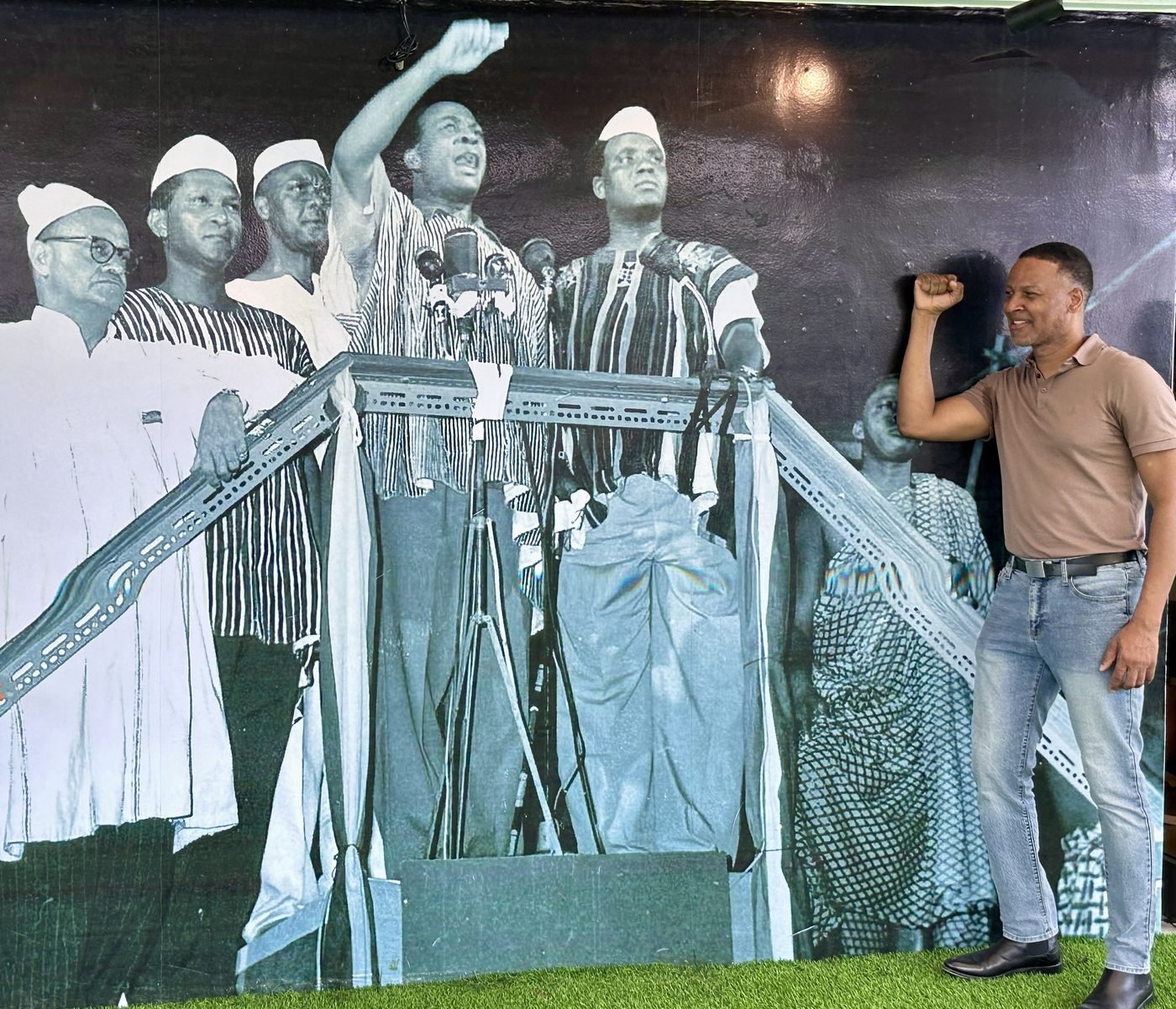
This is the harder charge. For three decades, Nkrumahists have accused the duopoly of building nothing for Ghana. It is a difficult accusation to sustain from a tradition that, over the same period, has built nothing for Ghana without the state.
Even the newest Nkrumahist formations tend to announce themselves the same way: a manifesto of everything they will do once elected, and nothing yet built.
Those questions matter more to the survival of Nkrumahism than another argument about who understands Nkrumah correctly.
Ghana in 2026 is not Ghana in 1960.
A young Ghanaian today lives in a world of artificial intelligence, smartphones, automation, global supply chains, cryptocurrencies, climate change, drones, biotechnology and digital economies. That young person may respect Nkrumah enormously while finding little reason to join a movement that seems more comfortable explaining 1966 than explaining 2036.
Update Nkrumahism
That is the central challenge.
The choice is not between abandoning Nkrumah and worshipping him.
There is a third possibility:
Update Nkrumahism.
Take seriously its emphasis on productive capacity, scientific education, African agency, industrialization and national development.
Interrogate the ideas that have aged poorly.
Retain those that remain useful.
Develop new ones where twentieth-century doctrine offers no adequate answer.
Welcome disagreement instead of treating it as ideological contamination.
Accept that an idea can remain recognizably Nkrumahist without being frozen where Nkrumah left it in 1966.
And above all, start building things.
Otherwise the transformation will quietly complete itself.
The political movement becomes a commemorative movement.
The organizing meeting becomes the memorial lecture.
The development program becomes the anniversary celebration.
The activist becomes the custodian of historical memory.
And eventually the movement becomes the Nkrumah Historical Society: exceptionally knowledgeable about what Nkrumah accomplished between 1951 and 1966, fiercely protective of his legacy, and increasingly unable to say what Nkrumahism intends to accomplish between 2026 and 2050.
There is no shame in a historical society.
But no one should confuse one with a political movement.
The tradition has spent three decades asking the wrong question: Who owns Nkrumah?
The question that matters is: Who is making Nkrumah's ideas useful to the Ghanaian living now?
Nkrumah's place in Ghana's history is secure. Nkrumahism's place in Ghana's future is not.
The numbers have already sounded the alarm. The rescue mission should have begun yesterday.
Sources: Electoral Commission 2024 results via Graphic Online (updated EC results; EC updates 2024 results); 1992 Ghanaian presidential election; Edward A. Ulzen Memorial Foundation; University of Ghana, Party Fragmentation in Ghana's Fourth Republic; NewsGhana, profile of John Atta Mills; 1996 Ghanaian general election; Paa Kwesi Nduom; Isaac Owusu-Mensah et al., "The State of Political Party Development in Ghana," Political Parties and the Crisis of Democracy (Oxford University Press, 2024), open-access copy; MyJoyOnline on the Axim Freedom Arch, the Osagyefo Roundabout and Buah at NkrumahFest; GhanaWeb; Graphic Online on the UCC honorary doctorate; Kwesi Pratt Jnr; Ashesi University, Our Story & History; Citi Newsroom and GBC on the GN Savings licence ruling and its disputed status.