The numbers that most previews will use to frame this match are straightforward: England ranked fourth in the world, Ghana ranked 65th. England beat Croatia 4-2 with eleven shots on target — more than any team in the opening round except Germany. Harry Kane scored twice. Jude Bellingham is four days away from becoming the youngest player in history to earn 50 England caps. Declan Rice and Elliot Anderson won the ball more than any midfield pairing in the tournament's first round.
Ghana ground out a 1-0 win over Panama with a goal in the 95th minute. Their first-choice goalkeeper is injured. Their best midfielder missed the opener because his visa application contained a false declaration about criminal charges. The aggregator websites are calling this a foregone conclusion.
They said something similar about Panama.
The Goalkeeper Question: Asare Is Non-Negotiable
Lawrence Ati-Zigi has been spotted in individual training with goalkeeping coach Daniel Gaspar, but his fitness for Tuesday remains uncertain. Reports indicate a groin injury that could keep him out for up to three weeks. Whether or not he is passed fit, the case for starting Benjamin Asare against England is compelling on its own merits — not simply by default.
Compare the two halves against Panama. In the first 45 minutes, Ati-Zigi made two crucial saves — particularly his second-minute reflex stop from Cecilio Waterman — and kept Ghana level when the scoreline could easily have been 2-0 or 3-0. That is not in dispute. But his distribution under Panama's press was a disaster. Every time he received the ball from his defenders, Panama closed immediately. Every release — whether a short pass to a defender or an attempted long distribution — was pressured into a turnover. The first half's 64% Panama possession and Ghana's zero shots on target were not solely Ati-Zigi's fault. But his inability to beat the press was a significant contributor to Ghana being trapped in their own half for 45 minutes.
Asare's second half was different in a specific and measurable way. He settled the defense quickly — organizing his back four, commanding crosses — and his distribution was noticeably more assured. He chose his moments: playing short when the option was clean, going long when it wasn't, and never gifting possession back to Panama the way Ati-Zigi had. Three saves. A clean sheet. The goalkeeping coach Daniel Gaspar has described Asare's performance as exactly what the team needed. I wrote this in the Black Stars Playbook in February and I will write it again now: the goalkeeper is not just a last line of defense. He is the first line of attack. Against England's high press, Ghana cannot afford a goalkeeper who turns every restart into an England possession.
The case for Asare goes beyond the Panama match. The argument I want to make is more fundamental — and it begins with the United States against Algeria in the 2010 World Cup.
The Tim Howard Doctrine: Distribution as the Decisive Weapon
June 23, 2010. Pretoria, South Africa. Algeria and the United States were level at 0-0 going into stoppage time. The US needed to win to advance. Algeria had dominated possession for long stretches. And then the game changed — not with a shot, not with a foul, but with a goalkeeper catch.
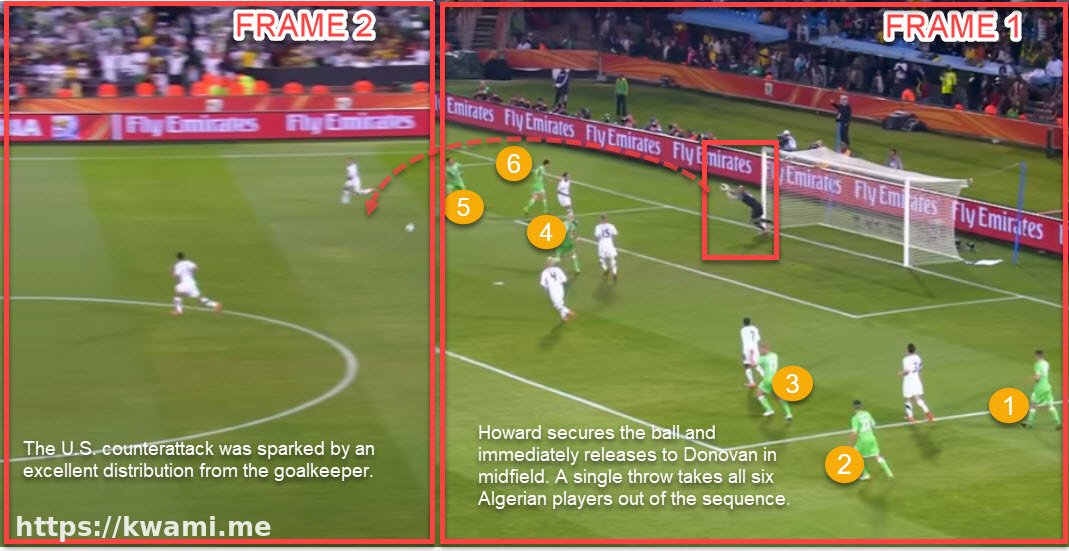
Tim Howard caught a late Algerian cross cleanly. In the second that followed, the entire Algerian team was committed forward — stretched, disorganized, caught between pressing and retreating. Howard read it instantly. Rather than distribute to a nearby defender and allow Algeria to reset, he threw the ball immediately — fast, flat, accurate — to find Landon Donovan on the American left.
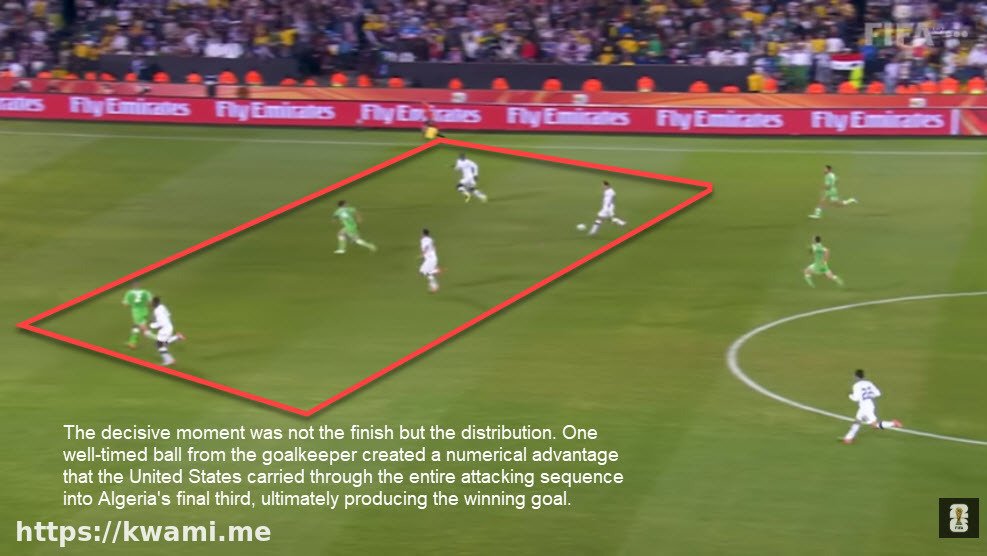
That throw launched a counter-attack that covered the length of the pitch in four seconds. By the time the ball reached the Algerian penalty area, more American players were in the box than Algerian defenders. Donovan finished. The US won. They advanced from the group stage.
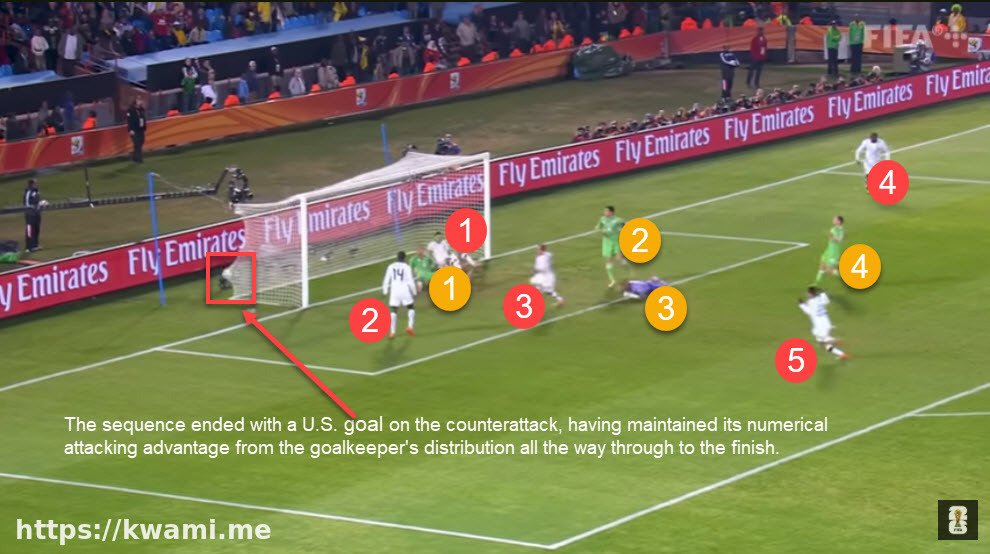
Watch the Howard sequence that proves the goalkeeper distribution argument — the catch, the instant release, the counter-attack, the goal: Watch on YouTube → USA vs Algeria, 2010 World Cup (from 2:25)
The point of that sequence is not nostalgia. It is architecture. A goalkeeper who can release immediately — before the press reorganizes, before the defensive line resets, before the opposition has time to position — converts a defensive moment into an attacking one before anyone on the pitch has processed the transition. Thrown balls travel faster than running players. The first three seconds after a goalkeeper receives the ball are more valuable than any midfield combination that follows.
This is the argument for Asare against England. England press immediately and intelligently. Rice and Anderson will be on Ghana's defensive midfielders the moment the ball goes back to the goalkeeper. A goalkeeper who holds the ball, hesitates, or plays short into a crowded central space will gift England possession in dangerous areas. A goalkeeper who can read the press, hold his nerve for one second, and find a runner in space behind England's midfield line turns England's pressing strength into a vulnerability. Asare showed against Panama — in a smaller way — that he can do this. Ati-Zigi, on that same evening, could not.
Start Asare. This is not a consolation selection. It is the tactically correct decision.
The Midfield: Partey and Sibo Together
Thomas Partey is back. He said so himself on Monday: "I feel okay and I'm ready to play." His presence in Boston removes the midfield crisis that plagued the Panama game. The question is not whether Partey starts. He does. The question is who starts alongside him.
The conventional answer is Elisha Owusu, who started against Panama. The better answer is Kwasi Sibo — who came on in the 77th minute against Panama and, in thirteen minutes, transformed the match. I wrote the full case in a separate dispatch. The condensed version: by the 80th minute, three minutes after Sibo's introduction, Panama had completely abandoned their press. Ghana went from zero shots on target to winning the match in thirteen minutes. The Guardian's live reporter noted it in real time.
The difference between Sibo and Owusu is not work rate or commitment. It is tempo. Sibo receives under pressure and plays forward. Owusu receives under pressure and plays safe. Against Panama, safe meant sideways and backward and eventually into a turnover. Against England — with Bellingham arriving late, Rice covering the ground between midfield lines, and Anderson winning possession more than any player in the first round — safe will cost Ghana the match.
Partey and Sibo together gives Ghana something it has rarely had: two midfielders who can both receive under pressure and play forward quickly. Partey provides the experience, the reading of the game, the press-breaking intelligence built over a decade at the highest level. Sibo provides the composure, the positioning, and the forward distribution that calmed an entire team in thirteen minutes against Panama. Together they can protect the back four and give Ghana's attacking players the platform they need.
Owusu is not the answer against England. He was overwhelmed by Panama. England's midfield is not Panama's.
Queiroz's heaviest defeat as a head coach at the FIFA World Cup was against England — his Iran side lost 6-2 in 2022. He knows what this opponent can do. He also knows that midfield control is the difference between a contest and a capitulation.
The Ayew Question: When Athleticism Becomes a Liability
Jordan Ayew against Panama made the most high-intensity pressures of any striker in the first round of the 2026 World Cup — 69 in total, 56 in the opposition half. That statistic reflects his effort and his commitment, and it should not be dismissed. At 34 years and 185 days, he became the oldest player ever to feature for Ghana at a World Cup. He is a veteran who gives everything.
But effort and effectiveness are different things. The hero ball that Queiroz correctly substituted against Panama — holding too long, trying one dribble too many, slowing attacks that needed to be quick — is not a character flaw. It is what happens when a player's athletic capacity declines faster than his desire to contribute. Ayew was always a player built significantly on physical intensity and pressing energy. As that athleticism fades, what remains is the will to do what the body can no longer do as efficiently. The result is hero ball.
Creatives endure. Athletes decline.
The pattern is not unique to Ayew. Cristiano Ronaldo, the most statistically extraordinary striker of his generation, built much of his output on explosive athleticism — pace, power, leap, and the sheer physical intensity of his movement off the ball. On June 17 at this very World Cup, the same day Ghana beat Panama, Ronaldo played 90 minutes for Portugal against DR Congo in Houston. He missed two clear chances — both set up by Francisco Conceição — sending the ball wide on each occasion. Portugal drew 1-1 with a team appearing in their first World Cup since 1974. Ronaldo took 29 touches. He was largely a peripheral figure. The Sky Sports match report noted bluntly that "he appeared to just be taking up space" and that Portugal's teammates "persisted at trying to find him at all costs" while "squandering better chances to give him the service." His coach Roberto Martínez stayed mum after the match rather than publicly confront the obvious. Portugal's best midfield in a generation — Bernardo Silva, João Neves, Bruno Fernandes — was diminished by the obligation to feed a Ronaldo whose athleticism can no longer convert the service into goals.
Contrast that with what happened the evening before — June 16 in Kansas City. Lionel Messi, 38 years old, with a hamstring worry that had concerned fans in the lead-up to the tournament, scored a hat-trick against Algeria. A long-range screamer in the 17th minute. A poacher's tap-in on the hour. A curled effort into the bottom corner in the 76th. He was then substituted to a standing ovation. Three goals, six shots, four touches in the opposition box — and he pressed, tracked back, and won duels in midfield at a rate that embarrassed players half his age. He equalled Miroslav Klose's all-time World Cup scoring record of 16 goals. He became the first player to feature in six World Cups. On his 200th Argentina appearance. Twenty years to the day since his World Cup debut.
The contrast between those two evenings — Ronaldo missing two open chances while Portugal drew with DR Congo, Messi scoring three against Algeria — tells the story of two different types of greatness and what happens to them with age. Ronaldo was built on explosive athleticism: the sprint, the leap, the physical dominance that turned chances into goals. As that athleticism declines, the chances no longer convert and the system designed to serve him becomes a liability. Messi was never built on pace. He was built on creativity — vision, timing, intelligence, and the ability to read space that others cannot perceive. That creative intelligence is what separates him from Ronaldo not just in style but in how he ages. Creative attributes do not decline with the body. If anything they deepen — the legs move less but the football mind moves faster. Messi at 38 is better at football than Ronaldo at 41 not because he is fitter, but because his game never required the physical gifts that time takes away.
Consider Diego Maradona — perhaps the strongest case study of the durability of football intelligence. Even as addiction, injuries, suspensions, and declining fitness eroded the athletic gifts that made him great, he remained capable of influencing matches through vision, anticipation, technique, and decision-making. He had a cocaine addiction that led to a 15-month ban in 1991 and eventually got him thrown out of the 1994 World Cup. He was hospitalized near death twice — in 2000 and 2004 — for heart problems. The 280 pounds that became his most cited physical statistic came after he retired — in the years of post-playing obesity, addiction, and illness that followed his career. During his playing years, his body was declining but not yet at that extreme. By every conventional athletic metric, his physical condition was seriously compromised for the final years of his career. He still retired at 37, having played competitive football for Boca Juniors until 1997. If athleticism were the primary determinant of longevity, Maradona's career should have collapsed years before it did. Instead, his football intelligence kept him relevant long after his physical peak had passed. Roger Milla scored his most famous World Cup goals at 38, from the bench — neither fast nor powerful, but creative, intelligent, and capable of finding pockets of space that purely athletic players would never perceive. Few examples better illustrate the staying power of creativity in football. Elite creativity ages better than elite athleticism.
Ayew is closer to Ronaldo's type than to Maradona's or Messi's. His best years were defined by relentless pressing, pace on the counter, and physical intensity. Those tools are declining. Against England's defensive organization — Guehi, Stones or Konsa, Alexander-Arnold or James — he will not win those battles the way he once would. Ghana needs pace and creativity on the ball against England, not effort alone.
The player Ghana should start in Ayew's place is Abdul Fatawu of Leicester. Fatawu is 21 years old, electric over ten to fifteen yards, capable of running in behind England's defensive line, and sharp enough in one-on-one situations to trouble even elite full-backs. He came on in the 57th minute against Panama and immediately changed the texture of Ghana's attack. He contributed to the winning goal sequence. Against England, his pace is not just an option. It is a weapon.
The England Threat — And Ghana's Structural Answer
England are genuinely dangerous. Kane has scored twice in one game and has nine goals in his last five appearances. Bellingham is 22 years old and is on the verge of his 50th cap — in those appearances he has been one of the three or four best midfielders in world football. Bukayo Saka and Noni Madueke give England wide threats that can stretch any defensive structure. Rashford is nursing a hamstring concern but trained Monday and is expected to feature.
England also have vulnerabilities. They conceded twice to Croatia — and Croatia are not, on paper, at Ghana's level of organized defending. Two goals conceded in a single match is a signal, not an anomaly. Ezri Konsa and John Stones were both culpable for Croatia's goals — individually exposed on transitions and caught flat-footed when the ball moved quickly in behind. Marc Guehi is likely to come in and shore up the defensive structure, but the underlying problem is systemic: Tuchel's attacking approach compresses the defensive line and creates space in behind that pace can exploit. England opened up at 4-2. The defensive line that conceded to Croatia's runners will face Fatawu's pace on the counter. Ghana's task is to get the ball to that space before England can reorganize. The blueprint for that goal already exists — and it begins with Asare's first touch.
Ghana's structural answer to England is the same answer that worked in the final thirteen minutes against Panama: compact defensive shape, press resistance in midfield through Partey and Sibo, and pace on the counter through Fatawu and Semenyo. England will control possession. That is not the problem. The problem is ensuring that when Ghana recover the ball — in their own half, under pressure — they can transition in three seconds rather than surrendering possession and inviting the pressure again.
That transition speed depends entirely on the goalkeeper. Asare, releasing quickly to a wide runner in space behind England's midfield press, is the mechanism. Sibo and Partey, receiving between the lines and playing forward before England resets, are the engine. Fatawu and Semenyo, running in behind a high defensive line on the counter, are the finishers.
Senegal proved in June 2025 — at Nottingham's City Ground, 3-1, the first African nation to beat England in men's football in 22 attempts — that England can be beaten by an African side when tactical discipline, transition speed, and belief meet England's defensive lapses. Ghana do not need to be better than England man-for-man. They need to make the match unstable, survive pressure, attack the spaces England leave, and turn moments into punishment.
The evidence is specific. England conceded twice to Croatia and Tuchel has publicly warned about defensive structure. Ghana's best route is not possession dominance — it is compactness, counters, set pieces, and forcing England into uncomfortable transitions. Reuters notes that Tuchel himself specifically expects Ghana's counterattacking threat. He has watched the tape. He knows what is coming. The question is whether his defensive line — the same one that conceded to Croatia's runners — can deal with Fatawu's pace and Thomas-Asante's physicality when Ghana spring the transition.
Senegal cracked the psychological ceiling in 2025. Ghana can crack the tactical one today. England have the stars. Ghana have the ingredients that trouble favourites: pace, chaos, resilience, and nothing to lose. Morocco reached the World Cup semi-finals in Qatar with the same combination — defeating Belgium, Spain, and Portugal not through superiority but through structure, belief, and clinical execution of moments. Football is not won on résumé. It is won in moments.
That is the case. Not "Ghana will beat England." But Ghana absolutely can.
Am I Being Too Optimistic? My Prediction
Let me be honest.
England are better than Ghana on almost every individual metric. Their depth is greater, their quality in the final third is superior, and their experience of winning tight matches is more established under Tuchel. The statistical models give Ghana around a 20% chance of winning. The bookmakers have England at roughly 1/5.
But Ghana won against Panama when they had a 29% chance in the simulations. Queiroz has beaten better teams than England with worse squads. His Iran side held the United States to a draw in 2022 before losing narrowly. His Portugal teams routinely outperformed their paper quality. And Ghana, with Partey back, Sibo starting, and Asare in goal, is structurally a more dangerous team than the one that ground out a 1-0 win with zero first-half shots on target against Panama.
A narrow Ghana win is not the most likely outcome. The most likely outcome is an England win. But it is not beyond the realm of serious analytical possibility — and a Ghana performance built on the blueprint above gives it a realistic chance.
My prediction: Ghana 1 — England 1. A draw that feels like a victory. Ghana defend deep, Partey and Sibo control the second ball, Fatawu exploits England's defensive line once on the counter. Kane probably scores because Kane always scores. Queiroz's tactical intelligence keeps it tight. Ghana advance to the last 32 before the final group game against Croatia.
A narrow win? Possible. A draw? The honest call. But if Asare starts and distributes well, if Sibo starts and controls the midfield, and if Fatawu's pace tests England's backline in the way Thomas-Asante tested Panama's — the first ten minutes of this match will feel very different from what England is expecting.
Start Asare in goal — not because Ati-Zigi is injured, but because the Tim Howard lesson is real. Distribution in transition is the weapon that turns defensive moments into attacking ones before the opposition can organize.
Start Partey and Sibo in midfield together. Two players who can receive under pressure and play forward. One with a decade of top-level experience. One who changed a World Cup match in thirteen minutes. Together they protect the back four and give Ghana's attack a platform.
Rest Ayew. His commitment is beyond question. His athleticism is in decline, and against England's defensive quality, pace and creativity on the ball are what Ghana needs. Start Fatawu — young, electric, and capable of running in behind England's line on the counter.
Predicted: Ghana 1 — England 1. A draw that sends Ghana to the last 32. But the blueprint exists for more than that — and Boston knows how to surprise people.
Full match analysis and player ratings after the final whistle. Come back.
Walter Kwami writes about football the way he writes about technology, nations, institutions, and development: as systems. Looking beyond statistics, narratives, and individual moments, he searches for the hidden structures and leverage points that shape outcomes. If Moneyball taught baseball to look where others weren't looking, this is that same instinct applied to the Black Stars.
Published June 23, 2026 · Kick-off 20:00 GMT / 16:00 EDT · Boston Stadium, Foxborough, MA