There is no satisfaction in this dispatch. The Milla Doctrine preview made three arguments: start the young legs, hold Jordan Ayew back as the closer, and keep Benjamin Asare in goal for his distribution. Queiroz did the opposite of all three. Ayew led the line. Iñaki Williams started wide. Lawrence Ati-Zigi replaced Asare in goal, and Jerome Opoku replaced Adjetey beside Luckassen — two changes to a settled defensive unit in one night. And Ghana exited the World Cup having failed to put a single shot on target across ninety minutes — an expected-goals tally of 0.26 against Colombia's 2.18, in a match Ghana had to win. Jhon Arias's 14th-minute finish, swept in at the far post from Luis Suárez's cross, was the only goal. It was enough by a distance.
Note the identity of the assist-maker, because the tournament kept teaching the lesson to the very end. Suárez was a substitute — on the pitch barely two minutes, replacing the injured Jhon Córdoba, when he produced the cross that decided a knockout tie. Colombia's fresh attacker changed the match on arrival. Ghana's freshest attackers watched from the bench until the 79th minute. That asymmetry is the whole story of Kansas City, and it was the whole story of Belgium against Senegal a week ago, and it was the whole story of Roger Milla against this same Colombia in 1990. The doctrine was not a theory. It was the operating manual of the round — for everyone except Ghana.
The Match: Controlled, Then Closed
Both teams lost a starter inside the opening quarter-hour — Córdoba for Colombia, Marvin Senaya for Ghana, whose replacement Alidu Seidu spent the evening in the fire against Luis Díaz. Colombia controlled the match from the first whistle: 54 percent possession, twenty attempts at goal, eight on target. Ati-Zigi kept the score respectable — his save from Johan Mojica's header before the break was outstanding, and the goal itself carried no blame. Díaz had a goal ruled out by a narrow offside and squandered a one-on-one just before the hour. Substitute Juan Fernando Quintero, on at 73', completed all nineteen of his passes and created five chances — more than any player on the pitch, and more than Ghana's entire forward line managed together. Queiroz's own post-match assessment was accurate: Colombia controlled the passing and the movement, and in doing so drained Ghana's fitness and their capacity to recover the ball and go forward.
Ghana's attacking return, for the record: zero shots on target, one attempt from inside the penalty area all night, and a forward line that Colombia's centre-backs handled without once being made uncomfortable. Antoine Semenyo was the lone bright spot — his driven ball across the face of goal early in the second half found nobody making a run, which is as concise a summary of Ghana's evening as any statistic.
The Photograph That Explains the Exit
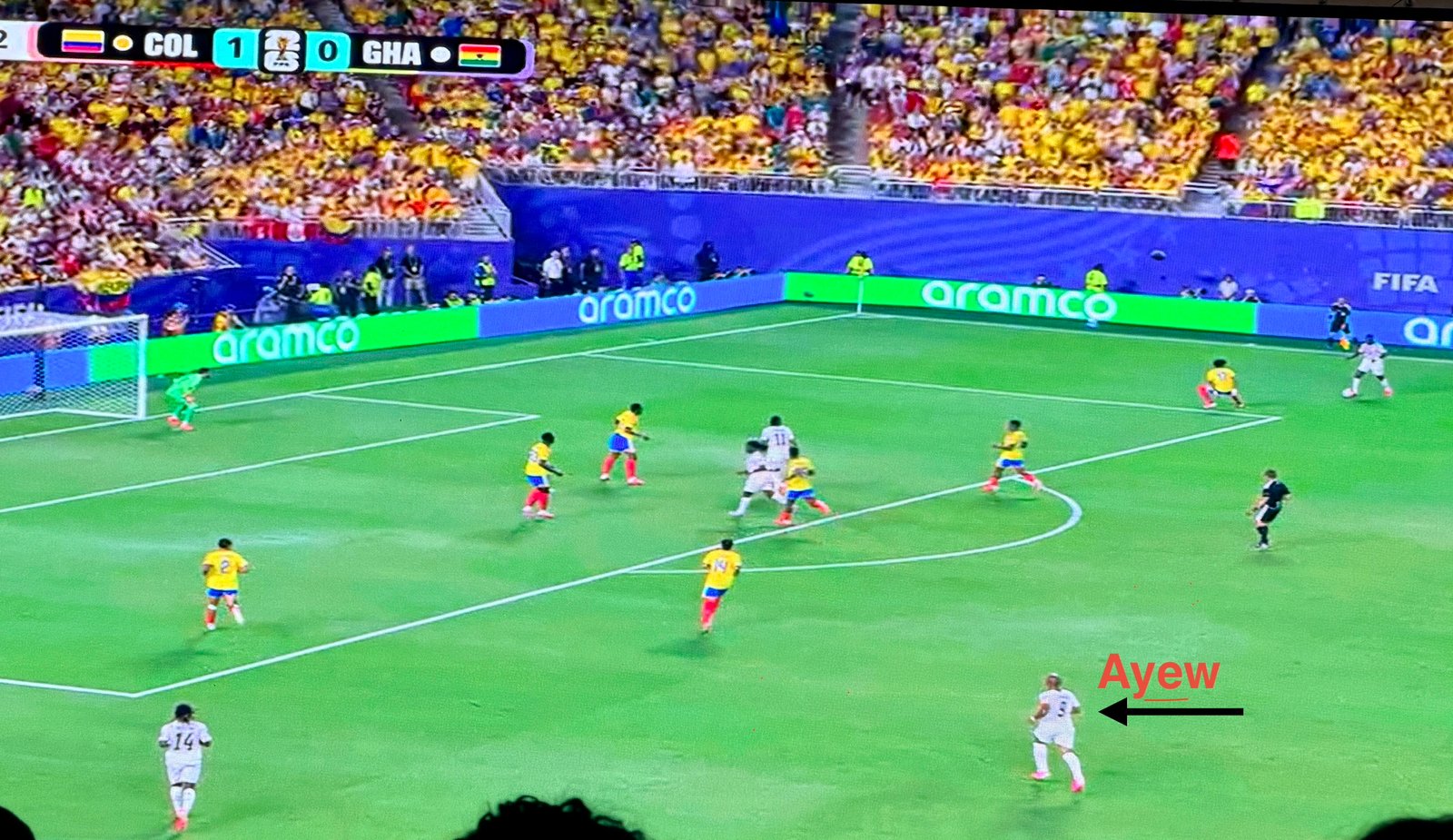
I argued in the preview that Ayew should not start this match, and I take no pleasure in the completeness of the vindication. His final numbers as a starting centre-forward in a World Cup knockout tie: zero shots, zero passes into the penalty area. Not few. Zero. The Athletic's tournament-wide accounting is harsher still — across Ghana's entire World Cup, Ayew registered zero shots and a single touch in the opposition penalty area. Four matches. One touch where strikers live. The image above captures the structural version of the same fact — in one of Ghana's rare forward surges, the number 9 is behind four of his own teammates, jogging in support of an attack he is supposed to lead. His work rate, the quality I have defended in this space across three dispatches, was never the issue. The issue is that work rate is a midfielder's virtue and a striker's consolation prize, and in a match Ghana had to win, the position demanded a predator.
I was not the only observer to reach for strong language. John Obi Mikel — a man who played in these matches for Nigeria and does not deal in manufactured outrage — delivered a post-match assessment as brutal as any I have seen aimed at a Ghana captain: a senior forward producing nothing in a knockout match, he argued, is not merely poor form — "that's hiding." His conclusion was that Ghana effectively played with ten, because their most experienced attacker gave Colombia's centre-backs nothing to defend, and that reputation alone earns nobody respect on this stage. Harsh. And on the evidence of ninety minutes in Kansas City, not unfair. The cruel coda: when Ayew and Caleb Yirenkyi made way for Ernest Nuamah and Prince Adu at 79 minutes, Ghana's attack finally breathed — movement, directness, bodies in the box. Eleven minutes of what the previous seventy-nine should have looked like. Too little, and far too late — but proof, in real time, that the personnel existed and the selection withheld them.
The Goalkeeper Decision: A Self-Inflicted Wound
Let me be precise about the Ati-Zigi critique, because it is not about shot-stopping. His saves were excellent — the Mojica stop was among Ghana's few moments of genuine quality — and the Arias goal owed nothing to any failing of his. The problem was the ball at his feet. Time and again, Ati-Zigi's distribution ended in Colombian possession, handing back the ball Ghana's defence and midfield had just bled to recover, and inviting the next wave of pressure onto a team that had no outlet. Against a side that controlled 54 percent of the ball and pressed intelligently, a goalkeeper who cannot relieve pressure with the ball is a structural leak, whatever he does with his hands. As I argued in the defensive system dispatch, a great distributing goalkeeper is effectively a twelfth outfield player — the first attacker as well as the last defender. Bench him, and you are not making a like-for-like change. You are playing a man down in the build-up.
This is what made the change self-inflicted. Benjamin Asare's case was never that he is the superior shot-stopper — it is that his composed, purposeful distribution initiates Ghana's transitions, the quality that anchored two clean sheets and the England blueprint. And there is a second dimension the team sheet ignored: chemistry. Asare had played five consecutive halves behind this defence — the full England and Croatia matches plus the closing stages against Panama — building the wordless understandings a back line runs on: when the keeper wants the ball back, which channel he clears toward, who drops for the short option under press. Ati-Zigi's tournament, by contrast, amounted to one half against Panama before injury. The official line was that a recovered Ati-Zigi simply reclaimed his shirt. But fitness restores availability; it does not restore rhythm. Ghana changed a functioning goalkeeper-defence unit on the eve of the biggest match in sixteen years — and compounded it by swapping Opoku in for Adjetey the same night, a second alteration to a settled structure.
Which is what makes Queiroz's own post-match diagnosis so damning of his team sheet. Colombia, he said, controlled the passing and the movement, and in doing so damaged Ghana's fitness and their ability to recover the ball and go forward. Accurate — and incomplete, because a meaningful share of that control was donated. Every Ati-Zigi clearance that landed on a Colombian shirt restarted the cycle Queiroz described: Ghana chase, Ghana recover, Ghana surrender, Ghana chase again — legs draining with each loop. The exhaustion the coach identified as the mechanism of defeat was partly manufactured by his own goalkeeping selection. He named the disease at the press conference having prescribed it at the team sheet — and went further, conceding that Ghana "made many mistakes" in possession and surrendered too many counter-attacks. Precisely. And the first mistake in possession, repeated all night, was the choice of who distributed it from the back. Ati-Zigi did not lose Ghana this match. The decision to disrupt a settled, functioning unit contributed to losing it — a wound entirely of Ghana's own making.
The Doctrine, Inverted
Set the preview's proposals against the team sheet and the pattern is total. The preview said start the pace — Fatawu and Adu began on the bench, Fatawu entering at 62' and promptly earning a booking born of chasing a match already shaped, Adu at 79'. The preview said hold the captain back as the closer — the captain started and was withdrawn at 79', the doctrine executed in reverse. The preview said keep the goalkeeper whose distribution starts the attacks — he sat. Even the substitution timing inverted the knockout logic argued in the Africa dispatch: changes made reactively at 62' and 79' in a match that demanded proactive ones by the hour. Kamaldeen Sulemana and Brandon Thomas-Asante — a tricky winger and a dynamic centre-forward, exactly the profiles a chasing team needs — never left the bench at all. And as the clock drained, Ghana abandoned the system entirely for long, hopeful balls: a team that had defended with discipline for four matches reduced, at the end, to prayer. The Athletic's verdict was that Ghana competed to the whistle but never fully released the handbrake. Colombia, meanwhile, ran the doctrine perfectly — Suárez the substitute created the goal, Quintero the substitute was the best player on the pitch. The two coaches were given the same lesson from the same week of football. One applied it.
Ghana's attack came alive in the 79th minute, the moment Nuamah and Adu crossed the touchline. That is not hindsight. It is the preview's argument, performed as evidence, eleven minutes before the final whistle of Ghana's World Cup.
Ghana — Full Match Grades
⚠ Grading context: Grades reflect positional impact, as always in this space. A knockout elimination with zero shots on target compresses the scale — but the defensive unit and goalkeeper are judged on their own briefs, not the forward line's failure.
| Player | Grade | Assessment |
|---|---|---|
| Lawrence Ati-ZigiGK · Full match | 6.0 | Two performances in one shirt. With his hands: excellent — the Mojica save was world class, and the goal carried no blame. With his feet: a structural liability, distribution repeatedly surrendering the possession Ghana's defence had bled to win. Graded on the whole brief, not half of it. |
| Marvin SenayaRB · Injured off 13' | N/A | Thirteen minutes ended by injury, no errors in them. Impact-based grading requires impact to grade; injury denied him the chance to register any. |
| Alidu SeiduRB · Sub on 13' | 5.5 | Thrown into the hardest assignment on the pitch — an unplanned 77 minutes against Luis Díaz. Beaten repeatedly early, booked at 76', but never stopped competing and was not directly at fault for the goal. A difficult night endured rather than mastered. |
| Jerome OpokuCB · Full match | 6.0 | Returned from injury straight into the deep end and held the line against twenty Colombian attempts. Solid in the duels — though his insertion for Adjetey was the second change to a settled defensive unit on the same night, and the unit played like a group still finding its references. |
| Derrick LuckassenCB · Full match | 6.0 | Solid in the duels, part of a back line that limited a 2.18 xG barrage to a single goal. Undone not by his defending but by the team's inability to keep the ball in front of him. |
| Gideon MensahLB · Full match | 5.5 | The goal came down his side, Suárez's cross arriving from his zone to find Arias unmarked at the far post. Recovered to a steady second half, but the decisive moment of the match happened in his channel. |
| Thomas ParteyMF · Full match | 6.0 | Available at last for a knockout match, and diligent in the screening role — but the match Ghana needed from him required progression, not just protection. Colombia's control of the middle third meant his tournament ended the way his visa saga ran: circumstances larger than his performance. |
| Kwasi SiboMF · Sub off 62' | 6.0 | Ran and harried as ever, but Colombia's midfield moved the ball too quickly for the destroyer's game to dictate as it did against Rice and Modric. Withdrawn at 62' — a substitution that weakened rather than strengthened, as the Africa dispatch warned. His tournament overall: Ghana's outfield discovery of 2026. |
| Caleb YirenkyiMF · Sub off 79' | 5.5 | A first knockout start that never found the game. Tidy without influence in a midfield that needed someone to break Colombia's rhythm. Made way in the double change that finally woke the attack. |
| Iñaki WilliamsFW · Sub off 62' | 5.0 | Started ahead of the young legs the preview argued for, and gave the selection no defence — anonymous in possession, rarely beyond the back line, withdrawn on the hour. The Fatawu start this occupied is the counterfactual that will linger. |
| Antoine SemenyoFW · Full match | 6.5 | Ghana's only consistent threat, playing through the ankle knock from Philadelphia. His second-half ball fizzed across an empty six-yard box — the image of a winger doing his job while nobody arrived to finish it. Deserved better around him all tournament. |
| Jordan AyewCF · Sub off 79' | 3.5 | Zero shots. Zero passes into the penalty area. As a starting number 9 in a knockout match his nation had to win, that is not a quiet game — it is an absence. The work rate that earned 204 group-stage pressures is a striker's consolation prize, and grading on positional impact, the position produced nothing. His lowest grade in this space, and the least arguable. |
| Abdul FatawuMF · Sub on 62' | 6.0 | Injected urgency the moment he arrived and was booked at 66' for the crime of chasing a match already lost in shape. Should have started — the third consecutive dispatch in which that sentence appears. |
| Elisha OwusuMF · Sub on 62' | 5.5 | Tidier than his Croatia cameo, but replacing Sibo with a like-for-like screener in a match requiring a goal was a substitution that answered the wrong question. |
| Ernest NuamahFW · Sub on 79' | 6.5 | Eleven minutes of the directness Ghana lacked for seventy-nine. The attack's pulse returned with his first touch. The tournament's recurring truth, one final time: his minutes never matched his impact. |
| Prince Kwabena AduFW · Sub on 79' | 6.5 | Immediate energy, immediate running in behind — the profile the starting line lacked from minute one. He and Nuamah gave the final eleven minutes more menace than the first seventy-nine combined. The preview named him to start. Kansas City showed why. |
Colombia 1, Ghana 0. Zero shots on target. An xG of 0.26. A World Cup that ends not with a collapse but with a whimper — the one exit mode this team's group stage had seemed to make impossible.
The verdict on the campaign must be written separately and generously: a first knockout appearance since 2010, two clean sheets, England held scoreless, a defensive system that restored the Black Stars' seriousness. But the verdict on Kansas City is selection. Ghana benched the goalkeeper whose feet build the attack, started the striker whose legs no longer lead one, and held the match-changers back until the match was beyond changing. The doctrine this space argued for was executed on the night — by Colombia, whose substitute created the winner and whose substitute was the best player on the pitch.
Ghana go home vindicated in the system and condemned by the selections. The next dispatch will reckon with the full campaign — what was built, what it proved, and what the Black Stars must carry into 2030. Colombia go to Vancouver. The arithmetic, at last, is finished.
Walter Kwami writes about football the way he writes about technology, nations, institutions, and development: as systems. Looking beyond statistics, narratives, and individual moments, he searches for the hidden structures and leverage points that shape outcomes. If Moneyball taught baseball to look where others weren't looking, this is that same instinct applied to the Black Stars.
Full Time · July 3, 2026 · Kansas City Stadium · Round of 32