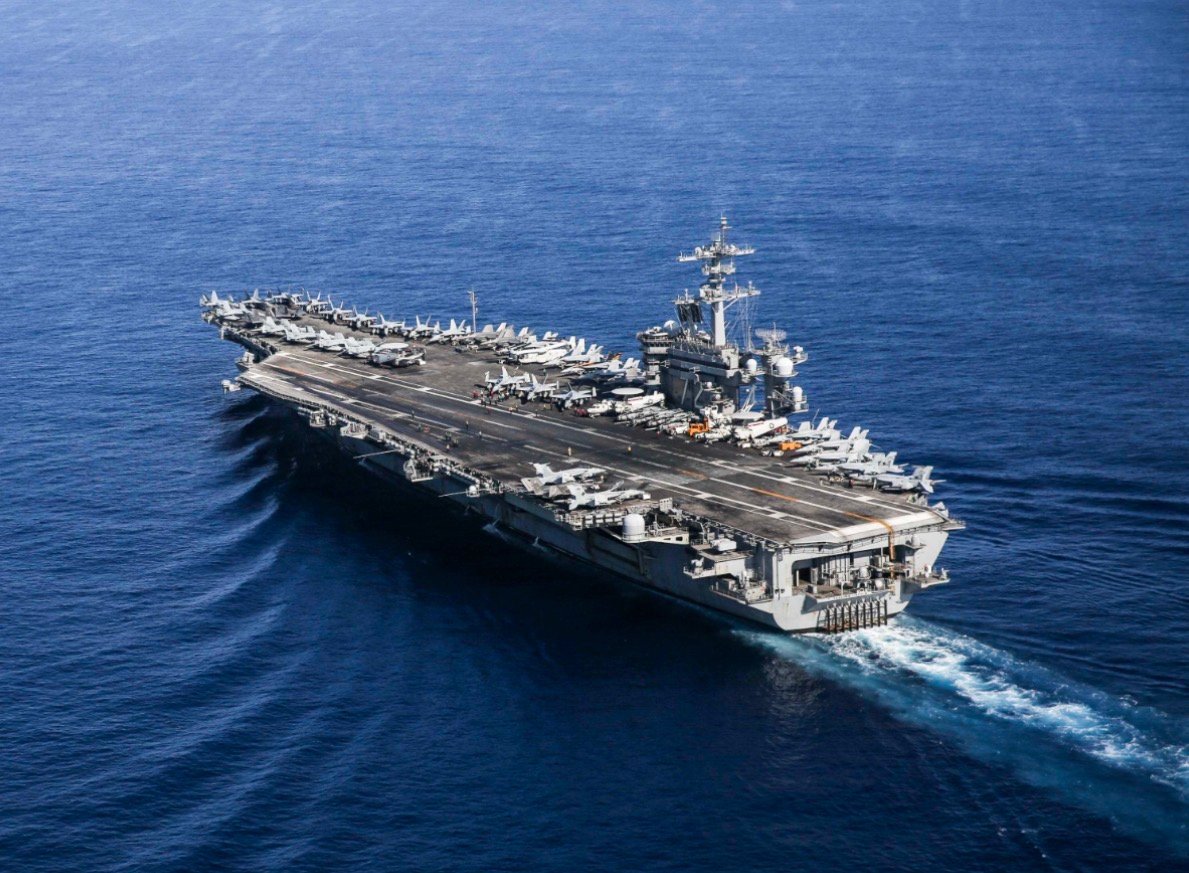
When political leaders ask "Where are the carriers?" in a crisis, they are asking a question that has defined American strategy for seventy years.
The answer comes in the form of two ship classes that have quietly shaped global power since the Cold War: the Nimitz-class aircraft carrier and the Arleigh Burke-class guided-missile destroyer.
The first is a floating city with its own airport. The second is a missile defense platform that can simultaneously track more targets than a regional air traffic control center.
Together, they form the core of American carrier strike groups — mobile bases that operate anywhere there is water, which covers most of the planet.
Understanding what these ships actually do requires stepping past the spectacle and into the engineering.
Arleigh Burke: The Sentinel
The Arleigh Burke-class destroyer is named after a World War II admiral who commanded destroyers in the Pacific. The first ship, USS Arleigh Burke, was commissioned in 1991. Seventy-four are now active. Twenty-five more are planned.
It is the most numerous warship class in the U.S. Navy. There is a reason for that: it works.
Arleigh Burke-Class Specifications
- Length: 505–509 feet (153–155 meters)
- Displacement: 8,300–9,700 tons
- Speed: 30+ knots (56 km/h)
- Crew: 350+ sailors
- Propulsion: Four LM2500 gas turbines, 100,000 shaft horsepower
- Range: 4,400 nautical miles at 20 knots
- Construction: All-steel hull with Kevlar armor over vital systems
The Burke's defining feature is the Aegis Combat System. Aegis integrates radar, weapons, and fire control into a single network. The AN/SPY-1D radar — four flat panels mounted on the superstructure — is a phased-array system that scans the entire sky electronically. No mechanical rotation. No blind spots.
The radar can track 72 targets simultaneously, display 48, and lock onto 12 for engagement. It detects aircraft, missiles, and surface contacts at ranges exceeding 150 nautical miles.
This capability matters in missile defense. When ballistic missiles arc toward a target, the Burke's Aegis system can identify the threat, calculate an intercept, and launch SM-3 interceptors — all in minutes. In April 2024, USS Arleigh Burke and USS Carney intercepted at least six Iranian ballistic missiles during strikes on Israel.
The ship's vertical launch system (VLS) is its armory. Ninety to ninety-six cells — depending on the variant — hold missiles in vertical tubes. Each cell can fire multiple types: SM-2 and SM-6 surface-to-air missiles for defense, Tomahawk cruise missiles for land attack, and VL-ASROC anti-submarine rockets.
The beauty of VLS is flexibility. The ship loads different missile mixes depending on the mission. Air defense? More SM-2s. Strike warfare? More Tomahawks. The system fires missiles rapidly — one every few seconds — and reloads at sea from supply ships.
The Aegis system was designed in the 1970s to defend against Soviet saturation attacks — waves of anti-ship missiles launched simultaneously to overwhelm defenses. That threat never materialized during the Cold War. But the system proved adaptable. Today it tracks ballistic missiles, coordinates fleet air defense, and even intercepts satellites in low orbit.
Beyond missiles, the Burke carries a 5-inch/54-caliber naval gun for surface bombardment and close-in defense. Two Phalanx CIWS (Close-In Weapon System) — six-barrel 20mm Gatling guns — provide last-ditch defense against incoming missiles. The guns fire 3,000 rounds per minute, autonomously tracking and engaging threats that penetrate the missile envelope.
For anti-submarine warfare, the ship deploys towed sonar arrays and helicopters. Flight IIA variants — starting with USS Oscar Austin (DDG-79) — include hangars for two MH-60R Seahawk helicopters equipped with dipping sonar, sonobuoys, and torpedoes.
Survivability was built into the design. The hull is all-steel — no aluminum superstructure like earlier classes. Vital spaces are protected by double-layered steel bulkheads and 70 tons of Kevlar armor. The ship has a Collective Protection System against nuclear, biological, and chemical contamination, allowing operations in contaminated environments.
The Burke class evolved through three "Flights" — incremental design improvements. Flight I and II (DDG-51 through DDG-78) focused on air defense and strike. Flight IIA (DDG-79 onward) added helicopter hangars and improved systems. Flight III, now entering service, upgrades to the AN/SPY-6 active electronically scanned array radar — more powerful, more sensitive, better against ballistic missiles.
A destroyer is not an independent actor. It operates as part of a strike group, providing air defense, missile defense, and anti-submarine protection for the carrier. Think of it as the shield. The carrier is the sword.
Nimitz: The Airfield
The Nimitz-class aircraft carrier is difficult to comprehend until you see one. At 1,092 feet long with a flight deck spanning 252 feet, the ship displaces over 100,000 tons fully loaded. It is among the largest warships ever built.
Ten Nimitz-class carriers are in service. The first, USS Nimitz, was commissioned in 1975. The last, USS George H.W. Bush, in 2009. They are nuclear-powered and designed for 50-year service lives.
Nimitz-Class Specifications
- Length: 1,092 feet overall (333 meters)
- Beam: 252 feet overall (77 meters), 134 feet at waterline (41 meters)
- Displacement: 100,000–104,000 tons fully loaded
- Speed: 30+ knots
- Crew: 3,200 ship's company + 2,500 air wing personnel
- Propulsion: Two Westinghouse A4W nuclear reactors, four steam turbines
- Range: Effectively unlimited (20+ years between refueling)
- Air Wing: 64–90 aircraft depending on configuration
The carrier's mission is simple: project air power. Everything else — the defensive systems, the nuclear reactors, the thousands of crew — exists to support flight operations.
A typical carrier air wing includes 36–48 F/A-18E/F Super Hornets for strike and air superiority, 4–12 F-35C Lightning II stealth fighters, 4–8 EA-18G Growlers for electronic warfare, 4–6 E-2D Hawkeyes for airborne early warning, and 6–8 MH-60R/S Seahawk helicopters for anti-submarine warfare and logistics.
The flight deck is where theory meets chaos. Four steam catapults — electromagnetic on newer Ford-class carriers — accelerate aircraft from 0 to 165 mph in two seconds. The catapults use steam pressure generated by the ship's nuclear reactors. Launch interval: 20 seconds. The ship can sustain 150 sorties per day during high-tempo operations.
Recovery is more violent. Returning aircraft snag one of four arresting wires with a tailhook, dragging the plane from 150 mph to a dead stop in under 400 feet. The arresting gear consists of two-inch steel cables connected to hydraulic rams below deck. Miss all four wires — a "bolter" — and the pilot goes to full throttle for another attempt.
The angled flight deck allows simultaneous launch and recovery operations. Aircraft launch from bow catapults while others land on the angled section. This design, pioneered by the British Royal Navy in the 1950s, revolutionized carrier operations.
Nuclear propulsion is the carrier's strategic advantage. Two A4W reactors generate enough power to run the ship and all systems for over 20 years without refueling. No fuel replenishment means no vulnerable tanker convoys. The ship carries 3 million gallons of aviation fuel and ordnance — all for the air wing.
The reactors also generate electricity. Eight steam turbine generators produce 64,000 kilowatts — enough to power a city of 100,000 people. Four distilling units convert seawater to 400,000 gallons of fresh water daily for propulsion, crew, and catapults.
For self-defense, the carrier relies on escorts — destroyers and cruisers with Aegis systems. But it carries its own last-resort systems: RIM-162 Evolved SeaSparrow missiles for anti-aircraft defense, RIM-116 Rolling Airframe Missiles, and Phalanx CIWS guns. Electronic warfare suites jam enemy radar. Decoy systems create false targets.
The crew structure is divided: ship's company operates the vessel; the air wing flies and maintains aircraft; and a small flag staff coordinates strike group operations. Over 5,700 personnel work, eat, and sleep aboard. The ship is a self-contained city with post offices, medical facilities, chapels, and bakeries that produce 1,500 loaves of bread daily.
Carriers are expensive. Construction cost: $4–5 billion. Annual operating cost: over $1 billion. A Refueling and Complex Overhaul (RCOH) at the 25-year mark costs another $3–4 billion and takes four years. Yet no other platform delivers the same capability. Carriers operate forward, independent of land bases, immune to host-nation politics.
How Carrier Strike Groups Operate
A carrier does not deploy alone. It operates as the centerpiece of a Carrier Strike Group (CSG) — typically one carrier, two guided-missile cruisers, two or more destroyers, one or two attack submarines, and a supply ship.
The destroyers and cruisers form concentric defensive rings. Outer ring: area air defense against aircraft and cruise missiles. Middle ring: ballistic missile defense. Inner ring: point defense against leakers. Submarines hunt enemy subs and surface ships.
The carrier's air wing extends the group's reach. E-2D Hawkeyes provide airborne radar coverage 200+ miles from the ship. EA-18G Growlers jam enemy radars and communications. F/A-18s and F-35Cs strike targets 500+ miles inland.
Coordination relies on data links. Link 16 connects all platforms — ships, aircraft, satellites — into a single tactical network. A radar contact detected by a destroyer is instantly visible to every ship and aircraft in the group. An F-35C can cue a destroyer's SM-6 missile to engage a target the fighter detected but cannot reach.
Logistics enable persistence. Combat Support Ships conduct underway replenishment — transferring fuel, food, ammunition, and supplies while both vessels steam at 12–15 knots. A carrier typically replenishes every 7–10 days during sustained operations.
USS Nimitz set a deployment record in 2020–2021: 321 days deployed, 330 days at sea. USS Dwight D. Eisenhower logged 206 consecutive days underway in 2019–2020 — a post-World War II record. These endurance feats showcase nuclear propulsion and at-sea logistics working in concert.
Why Floating Airports Matter
Naval power is about presence and access. Land bases require host-nation agreements. Permission can be revoked. Basing rights are negotiated, conditional, politically fragile.
Carriers operate in international waters. They require no permission. They are sovereign U.S. territory that moves at 30 knots.
This matters in crises. During the 1996 Taiwan Strait crisis, the U.S. deployed two carrier strike groups to waters near Taiwan as China conducted missile tests. The message was clear without firing a shot.
Carriers also provide humanitarian relief. After the 2004 Indian Ocean tsunami, USS Abraham Lincoln launched helicopters delivering supplies and medical care. The ship's distilling capacity provided fresh water. Its hospital treated casualties. The flight deck became a helicopter hub.
But the primary mission remains combat. Since the 1970s, Nimitz-class carriers have participated in operations across the globe: the Gulf War (1991), Kosovo (1999), Afghanistan (2001), Iraq (2003–2011), Libya (2011), Syria (2014), and ongoing operations against ISIS.
The Arleigh Burke-class has proven equally versatile. Destroyers enforce no-fly zones, conduct missile strikes, provide ballistic missile defense, escort merchant ships through piracy zones, and hunt submarines.
Naval power is not romantic. It is logistics, engineering, and endurance. It is four steam catapults launching aircraft every 20 seconds. It is Aegis radar tracking 72 targets while calculating ballistic missile intercepts. It is nuclear reactors running for two decades without refueling.
The Nimitz-class and Arleigh Burke-class were designed during the Cold War to counter the Soviet Navy. That threat no longer exists. But the ships remain relevant because they were built for capability, not threat.
Missile defense, power projection, sea control, humanitarian relief — the platforms adapt to the mission. That adaptability, more than any single weapon system, explains their longevity.
When political leaders ask "Where are the carriers?" they are asking: Where is our movable, sustainable, sovereign military base that requires no permission and answers to no foreign government?
The answer is: wherever we sent them.
Technical Sources: U.S. Navy fact files, Naval Sea Systems Command documentation, Federation of American Scientists military analysis database, Jane's Fighting Ships, Congressional Research Service reports on naval capabilities. All specifications current as of 2025. This dispatch provides general educational information on naval capabilities and is not connected to any ongoing military operations.